The Hidden Emotional Cost of Data Breaches

The playbook for responding to a data breach has become almost ritualistic in its predictability. Organizations advise affected customers to change their passwords, offer complimentary credit monitoring services, and encourage vigilance against identity theft. Should financial fraud occur, established processes exist to recover monetary losses. This response framework treats data breaches as fundamentally financial events, ones that threaten wallets and credit scores but leave other dimensions of victims' lives untouched.
New research suggests this assumption is profoundly mistaken.
A survey of 552 Australian data breach victims reveals a landscape of harm that extends far beyond bank accounts. While 29 percent of respondents reported financial impacts, a full half experienced emotional harm from their breaches. Nearly one-third said their physical well-being suffered. And almost a quarter reported damage to their personal relationships. The numbers tell a story that the standard breach response fails to acknowledge: for most victims, the deepest wounds are invisible ones.
When Digital Exposure Becomes Personal Crisis
Understanding why data breaches inflict such broad harm requires recognizing how thoroughly our lives have migrated into digital form. Health records now contain not just names and addresses but detailed accounts of diagnoses, treatments, and medical procedures. Dating profiles capture intimate preferences and desires. Cloud storage holds private images ranging from personal photographs to sensitive medical scans. When this information spills into unauthorized hands, the exposure touches aspects of identity that have nothing to do with creditworthiness.
The anxiety that follows a breach often takes a form distinct from financial worry. Victims describe living with perpetual uncertainty, wondering each day whether their exposed data will surface in unexpected and damaging ways. Will today bring a fraudulent transaction? A scam caller armed with enough personal details to seem legitimate? An unwanted revelation to family members, employers, or friends? This psychological burden persists regardless of whether tangible financial harm ever materializes.
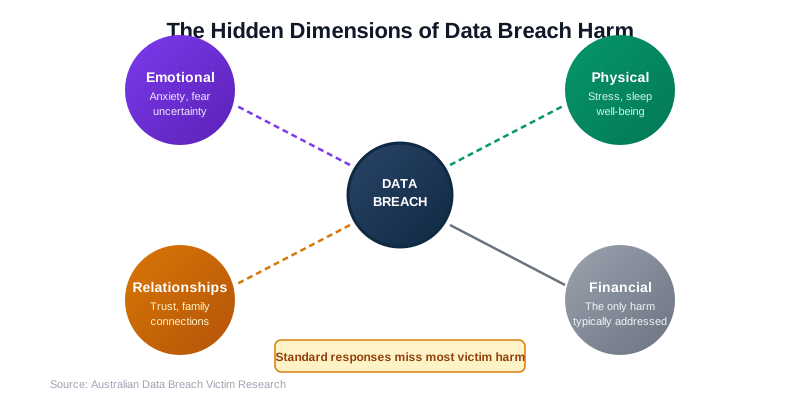
The research illuminates something that breach notification letters rarely acknowledge: the violation people feel when their private information escapes their control extends to their sense of safety, their peace of mind, and their relationships with others. A stolen credit card number can be cancelled and replaced. The feeling that strangers possess intimate knowledge about your health, your romantic life, or your family proves far more difficult to resolve.
Recognition as the First Step
Addressing these overlooked dimensions of breach harm begins with simple acknowledgment. Victims who understand that emotional distress represents a normal response to privacy violations can better process their experiences. Mental health professionals who recognize data breaches as potential sources of genuine psychological harm can offer more appropriate support. And organizations that grasp the full scope of damage their security failures cause may find greater motivation to prevent them.
The question of who bears responsibility for providing this support raises genuinely difficult challenges. Compensating potentially millions of victims for nonfinancial damages would involve complexity and cost on a scale that current breach response frameworks cannot easily accommodate. Yet victims of other personal crimes routinely receive access to support services that assist with their recovery. There seems no principled reason why data breach victims should be excluded from similar consideration.
Several possibilities merit exploration. Breached organizations might cover costs for counseling and psychological support, with qualification requirements ensuring resources reach those who genuinely need them. Cyber insurance policies could evolve to include coverage for therapeutic services, though premium adjustments would likely follow. Victims' own health insurers might recognize breaches as legitimate sources of mental or physical harm warranting medical intervention. And existing government and nonprofit victim services organizations could expand their scope to include this increasingly common form of violation.
Beyond the Password Reset
The transformation required extends beyond adding new line items to breach response budgets. Organizations must begin treating data protection as a matter of human welfare rather than merely regulatory compliance or financial risk management. When security failures occur, communication with affected individuals should acknowledge the full range of potential impacts rather than focusing exclusively on financial monitoring.
This shift in perspective carries implications for prevention as well as response. Investments in security that might seem difficult to justify when measured against potential fraud losses take on different significance when emotional harm to thousands or millions of people enters the calculation. The business case for robust data protection expands when organizations recognize they are safeguarding not just financial assets but the psychological well-being of everyone whose information they hold.
The research from Australia provides empirical grounding for something many breach victims have long understood intuitively: the violation of having private information exposed extends far beyond any financial consequence. As our lives grow ever more deeply intertwined with digital systems, the gap between how we think about data breaches and how victims actually experience them becomes increasingly difficult to ignore. Closing that gap requires acknowledging harm that standard metrics fail to capture and developing responses adequate to address it.
Having explored how data breaches inflict far more than financial harm, you may be wondering how to develop security strategies that protect your stakeholders more comprehensively. Our team of experts is ready to help you discover how human-centered approaches to cybersecurity could transform your data protection framework. Contact us to learn more.